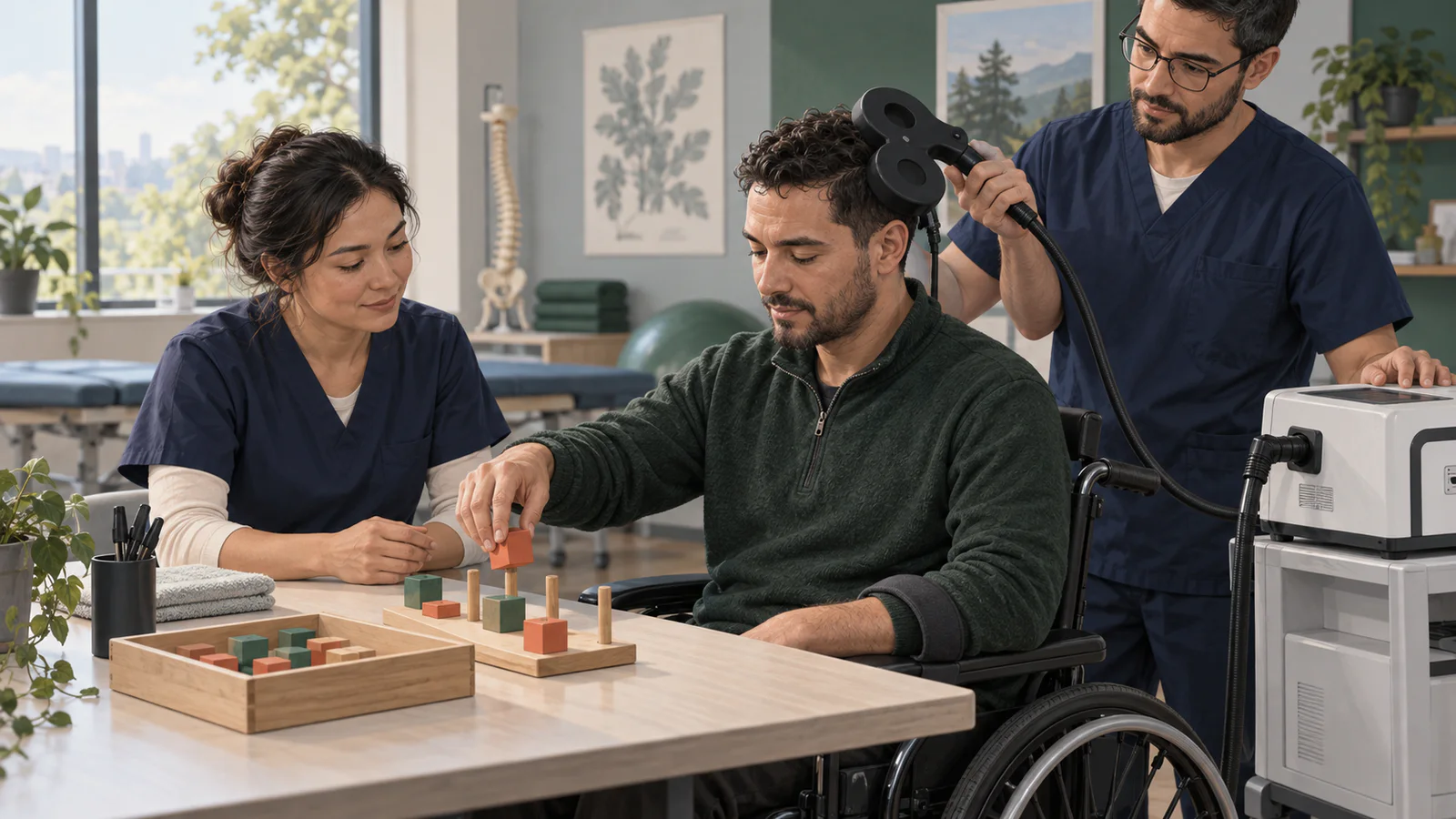
Analysis based on the September 22 Spinal Cord randomized trial and its PubMed record, a related randomized trial from the same rehabilitation center, and an open-access systematic review of noninvasive brain stimulation after spinal cord injury.
A magnetic coil has moved a little closer to the occupational therapy table. In a randomized trial published September 22 in Spinal Cord, 29 people with cervical spinal cord injury received five weeks of OT paired with either active repetitive transcranial magnetic stimulation or sham stimulation. The active group posted stronger upper-limb and independence gains in the public abstract. The result deserves attention, along with a pencil kept firmly beside it.
In brief
- The trial randomized 29 people with cervical spinal cord injury to active or sham rTMS while both groups received OT three times a week for five weeks.
- The active group had stronger gains on upper-limb domains and the Korean Spinal Cord Independence Measure, according to the abstract, which does not provide the effect sizes or longer-term follow-up needed to judge clinical importance.
- A 2023 review found no significant pooled upper-extremity benefit from noninvasive brain stimulation after spinal cord injury, and a related 30-person trial from the same center found no clear rTMS advantage when both groups received robotic therapy.
Twenty-nine people and 15 treatment sessions
Researchers at South Korea's National Rehabilitation Center assigned 14 participants to active rTMS plus OT and 15 to sham rTMS plus OT. Treatment ran three times a week for five weeks. Repetitive transcranial magnetic stimulation uses a coil at the scalp to deliver magnetic pulses intended to influence cortical excitability. The sham group helps separate the effect of that stimulation from attention, expectation, repeated assessment, and the OT received by everyone.
The primary upper-extremity measures were the Graded and Redefined Assessment of Strength, Sensibility, and Prehension, known as GRASSP, and a hydraulic hand dynamometer. GRASSP was built for the hand and arm consequences of tetraplegia, giving the trial a more useful target than a broad motor score alone. Secondary measures covered independence, pain, spasticity, and depression.
That structure is the study's strongest feature. Every participant received therapy, stimulation was compared with a sham, and the outcome set reached from body function toward daily independence. A device trial becomes more relevant to OT when its measurements can follow the hand into an actual task.
The signal reaches beyond grip
The active group showed larger improvements than the sham group in the abstract's reported strength, sensation, and hand-performance domains. It also improved more on the Korean version of the Spinal Cord Independence Measure III, which tracks everyday independence after spinal cord injury. That second result gives the paper its practical interest. A stronger hand matters most when the gain carries into feeding, dressing, transfers, mobility, or another part of daily life.
The publicly available abstract does not identify which independence items changed, how large the between-group differences were, or how many participants crossed a threshold that a patient would notice. It also does not report confidence intervals or a follow-up after treatment ended. The study therefore establishes a signal, rather than a treatment estimate ready for scheduling, staffing, or coverage decisions.
The OT intervention also needs a fuller description before another clinic could reproduce it. Frequency is clear. The accessible record does not spell out the activities, progression rules, intensity, therapist training, relationship between stimulation and task practice, or whether the same treatment priorities were used in both groups. Those details may decide whether a neuromodulation protocol supports occupation or simply shares a calendar with it.
Earlier evidence keeps the claim narrow
A 2023 systematic review pooled 14 randomized trials with 225 participants. Nine studied rTMS and five studied transcranial direct current stimulation. The review found signals for lower-extremity strength, balance, and spasticity, with important heterogeneity. It found no statistically significant advantage for upper-extremity strength, function, or spasticity. The new trial adds fresh evidence in the very area where that pooled record was thin.
A related randomized trial from the same Seoul rehabilitation center offers another useful comparison. Thirty people received either active or sham rTMS while both groups completed upper-extremity robotic therapy, again across 15 sessions in five weeks. Both groups improved on GRASSP domains, and the investigators found no significant between-group advantage from active stimulation.
The two trials do not cancel each other. They leave several live explanations: the paired training may matter, the participants may differ, the stimulation protocols or outcome timing may differ, and a small sample can move with chance. Replication across centers is the cleanest way to sort those possibilities.
Pain, spasticity, and mood stay in the frame
The newest abstract reports higher pain, spasticity, and depression scores in both groups after treatment. Shoulder pain rose significantly in the sham group, and depression scores rose significantly in both groups. The abstract does not explain the cause, duration, or clinical size of those changes.
Those findings belong beside the functional gains. Intensive upper-extremity practice can expose shoulder load, fatigue, frustration, positioning problems, and the emotional weight of repeated performance testing. A future protocol needs planned surveillance for all four domains: function, pain, tone, and mood. Reporting only the improving line would give clinicians and patients an incomplete study.
What spinal cord injury teams can do now
One small randomized trial does not establish rTMS as routine upper-extremity care after cervical spinal cord injury. It does justify a closer look at the full paper and a better-designed next study. Teams considering research or an investigational service should ask for the stimulation parameters, eligibility rules, baseline balance, adverse-event table, OT treatment manual, effect sizes, confidence intervals, and durability data before discussing implementation.
Any protocol should begin with a patient-chosen occupation and pair it with standardized measures such as GRASSP and an independence scale. Pain, shoulder integrity, spasticity, fatigue, and mood need scheduled checks and clear stopping rules. The record should show exactly when stimulation occurred in relation to task practice and which part of the daily activity changed.
The larger research question is now sharper. Investigators need to learn who benefits, which task practice best uses the stimulation window, and whether the gain survives after the coil leaves the room. This trial gives that work a credible starting point. It does not give the field a finish line.